

Published September 2021 and kept as a record. The figures and the law have moved on since it was written. For the current position see the Employment Rights Hub. Note added 21 October 2026.
The changes were due to be implemented in April 2020 but, on the evening of 17 March 2020, the Government announced the decision to delay the implementation of the IR35 changes in the private sector by one year to 6 April 2021.
It is now time to act on IR35. Read on to find out how IR35 will impact on you and how our advice and Toolkit can help.
Paul Scope, joint head of the Newcastle Employment team at Ward Hadaway, explains all you need to know. Paul hosted an hour long webinar on Thursday 4th February via Zoom with expert colleagues Roisin Patton, Peter Byrne and Rachel Blythe, to talk you through how this change will impact you, whether you are a business, contractor or agency. You can watch the video below.
IR35 legislation dates back to the year 2000 and hit contractors working predominantly in the IT, banking and public sectors. It aims to ensure that HMRC collects tax from those people who are essentially ‘employees’ disguised as limited companies for tax reasons.
Since then, the legislation has placed the onus on the individual contractor to determine their employment status – but in reality, many contractors either don’t realise or have chosen to ignore the rules.
Changes to the legislation mean that from April 2021, in the private sector it will be the responsibility of the end-user client – and in some cases recruitment companies – to ensure that contractors are compliant with IR35 legislation. Those businesses who aren’t compliant with the new rules could face large tax bills and penalties. Changes to IR35 legislation in 2017 already placed this obligation on public sector bodies.
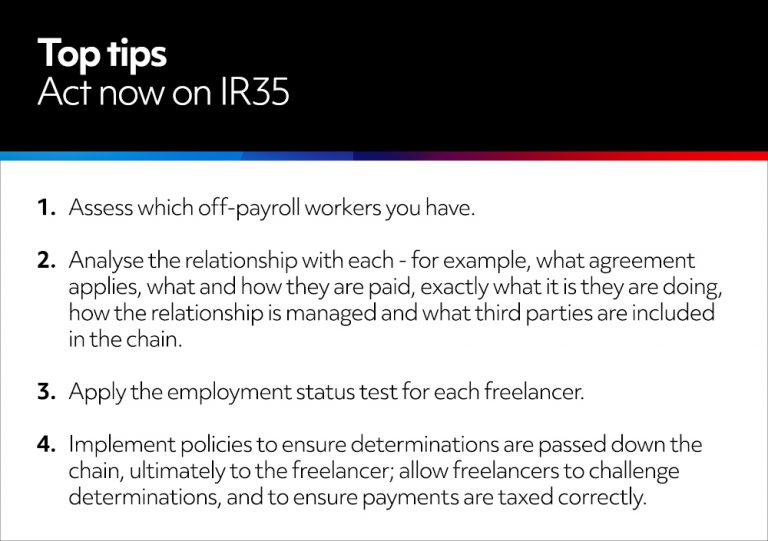
Q. What are your top tips for businesses, agencies and contractors who think they may be affected by this?
End users, agencies and contractors should act now:
Q. Where can we get help?
We have developed a toolkit to assist with compliance. The Toolkit contains a specimen contract; detailed guidance; step by step guides and flowcharts; details of the factors to take into account for the status determination test; procedures for challenging the determination; and standard letters for the process. Please contact Paul for further information on the Toolkit, which contains:
- Detailed guidance in the form of Key Facts
- Employment status checklist
- Employment status assessment flowchart
- Status questionnaire and guidance
- Letter confirming self-employed status (agency)
- Letter confirming employed status (agency)
- Letter confirming self-employed status (direct with PSC)
- Letter confirming employed status (direct with PSC)
- Status disagreement process guidance
- Status disagreement process flowchart
- Letter confirming outcome of status disagreement process
- Consultancy agreement
Q. Where can we get further information?
We have developed FAQs to give you a better understanding of IR35 which can be accessed on our Hub by clicking here.
Changes to the IR35 legislation were introduced in April this year, but they have left many businesses and contractors in many sectors confused.
The IR35 status of someone employed by your company is pivotal in determining the employee’s responsibility for paying tax. If an individual is deemed to be inside IR35, the employer will be responsible for paying tax on their behalf at their normal rates. However, should an individual be outside IR35, they would need to pay the amount themselves. Since the introduction of the ‘reform’ of IR35 in 2021, it is now more complicated for employers to determine whether a contractor operates under IR35 legislation.
Looking closely at short term talent
Ensuring compliance should be the priority for businesses working with contractors and freelancers. In today’s highly competitive recruitment market, employers need a partner who can ensure they comply with the latest changes and minimise the risks associated with contractors’ use.
If you aren’t comfortable with the idea of a contractor working with your team it may be tempting to think that if you aren’t paying them, you don’t need to care about what they are doing. Think again. If your company is seen as not caring about contractors, then you might find yourself struggling to recruit good people in the future.
Flexible resourcing specialists can offer a solution that makes sense for project managers and company managers alike. By hiring specialist short-term expertise and temporarily increasing team numbers, some projects can be delivered on time and some benefit from better quality because of greater awareness of knowledge levels within the team.
Some employees aren’t within the same IR35 framework as UK employees and work remotely without a physical presence and this is something to adhere to while working on finding new solutions for international recruitment. This has opened up more opportunities and allows businesses to access a wider talent pool.