
BIOR REPORTS
State of Recruitment, October 2026
Published 7 October 2026 · Data source, ONS Labour market overview, UK, and Vacancies and jobs in the UK, September 2026 release (15 September) · Next note after the 20 October ONS release
In brief. The UK had 702,000 vacancies in June to August 2026, down 8,000 on the quarter and 36,000 on the year, the lowest level outside the pandemic since August to October 2014. The fall is concentrated in the smallest employers. Unemployment is 4.9%, payrolled employment is drifting down, and regular pay growth has settled at 3.5%. For a recruitment agency the market is not collapsing; it is thinning at the bottom and holding in the middle.
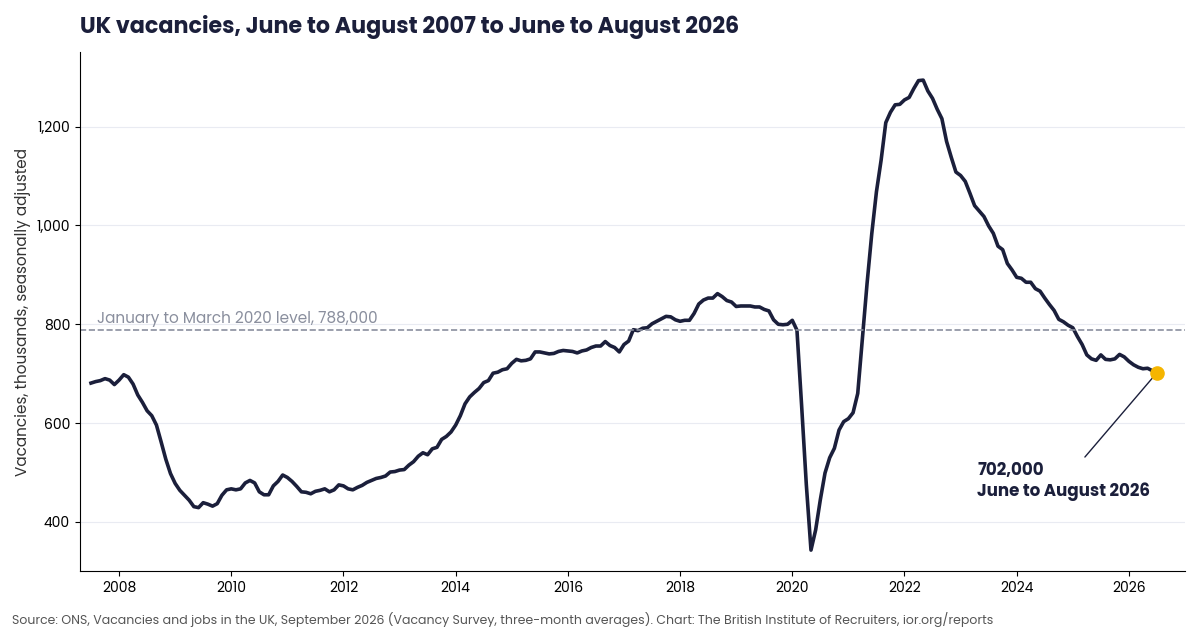
Vacancies. The Office for National Statistics estimates 702,000 vacancies in June to August 2026, 1.1% fewer than in March to May and 4.9% fewer than a year earlier. The level has been broadly flat since the start of the year, down only 16,000 since January to March, and the quarterly change sits inside the survey's confidence interval of about plus or minus 32,000. The vacancy rate, unfilled jobs as a share of all jobs, is 2.1%, unchanged on the quarter. There are 2.5 unemployed people for every vacancy, the same ratio for the fifth quarter running.
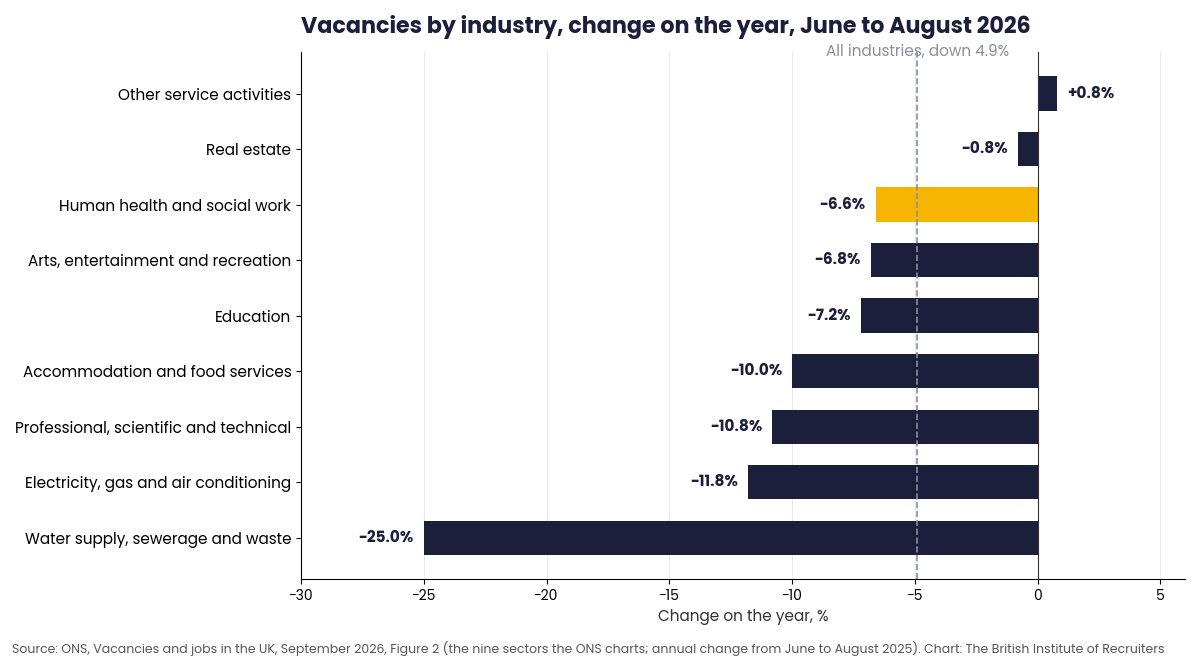
Ten of the eighteen industry sectors recorded fewer vacancies on the quarter. Education had the largest fall (down 5,000, or 9.7%). On the year, human health and social work activities had the largest volume fall, down 9,000 (6.6%), followed by professional, scientific and technical activities and by accommodation and food services, each down 8,000. The highest vacancy rates are in mining and quarrying (2.9%), accommodation and food services and financial services (2.8% each); the lowest in education (1.5%) and arts and recreation (1.6%).
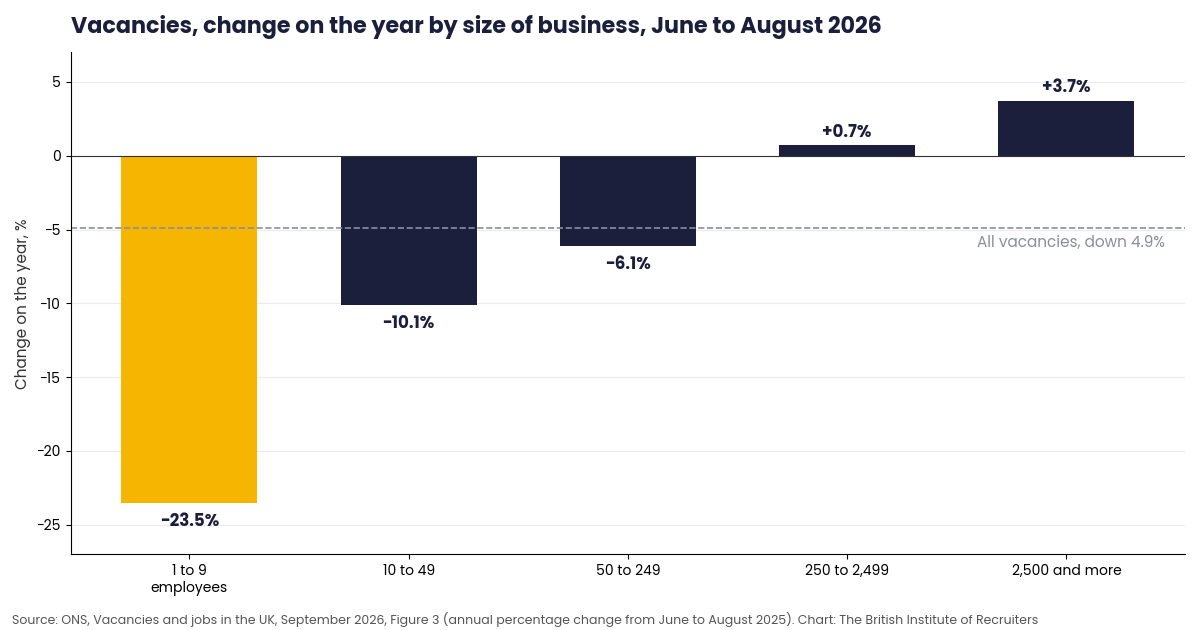
Where the fall is. Businesses with 1 to 9 employees had 91,000 vacancies, down 7,000 (7.5%) on the quarter and 28,000 (23.5%) on the year, the lowest for that size band outside the pandemic since late 2013. Businesses with 10 to 49 employees were down 11,000 (10.1%) on the year. The ONS reports that feedback from its Vacancy Survey "continues to suggest that smaller firms may not be recruiting because of increases in labour costs". The larger size bands held. For an agency, that is the whole picture in one line. The clients most likely to have stopped recruiting are the smallest, and the clients still recruiting are the ones with procurement teams, frameworks and questionnaires.
Employment, unemployment and pay. Payrolled employees stood at 30.2 million in the August flash estimate, down 26,000 on the month and 145,000 (0.5%) on the year; the ONS says the series has generally been falling for two years and that it remains the most reliable measure of employees. The unemployment rate was 4.9% in May to July, up 0.2 points on the year but unchanged on the quarter; the employment rate for 16 to 64 year olds was 75.1%; economic inactivity was 20.9%. The Claimant Count rose to 1.692 million in August.
Regular pay (excluding bonuses) grew 3.5% on the year in May to July, the same reading for five consecutive periods after a year of slowing; total pay grew 3.9%. In real terms, after CPIH inflation, regular pay rose 0.6%. Public sector regular pay grew 6.3% against 2.9% in the private sector, which the ONS attributes to the timing of pay awards.
Jobs. There were 36.7 million workforce jobs in June 2026, up 60,000 on the year but down 48,000 on the quarter, the quarterly fall almost all in self-employment jobs (down 43,000). The largest quarterly falls by industry were in human health and social work (down 67,000, mostly self-employment) and construction (down 23,000). The largest annual rises were in professional, scientific and technical activities (up 51,000) and public administration (up 45,000).
What it means for agencies. Three things. First, a flat market with 2.5 candidates per vacancy is a market where the agency's value is selection and compliance, not sourcing; the clients still hiring can find people and want them checked, documented and placed without risk, which is why the Institute's library this quarter is files, questionnaires and procedures rather than sourcing tips. Second, the smallest clients are the ones going quiet, so an agency weighted to micro-businesses should expect the thinning to continue into the winter and look up the size bands for its next clients. Third, the sectors with the largest annual falls in vacancies, health and social care among them, are also the most regulated, and in a regulated sector an agency that can show its file wins the work that remains.
Chart of the week, 14 October 2026. Vacancies at businesses with one to nine employees were 91,000 in June to August 2026, down 7,000 on the quarter and 28,000 (23.5 per cent) on the year, the lowest outside the pandemic since November 2013 to January 2014, when there were 88,000. Source, ONS, Vacancies and jobs in the UK, September 2026.
Chart of the week, 21 October 2026. There were 2.4 unemployed people for every vacancy in June to August 2026, down from 2.5 and the level the ratio has held since July to September 2025. Vacancies were 691,000 in July to September, down 21,000 on the quarter, the first reading under 700,000 since February to April 2021. Source, ONS, Labour market overview, UK, October 2026, and Vacancies and jobs in the UK, October 2026, released 20 October. Our news item on the release.
The next ONS release is on 17 November 2026. This note is updated on the first Wednesday of each month.
Every figure above comes from the Office for National Statistics, Labour market overview, UK: September 2026, and Vacancies and jobs in the UK: September 2026, both released 15 September 2026; the charts are drawn from the bulletin's own figures. This note is general information for BIOR members and the wider recruitment community, not advice on any individual business decision. Written by The BIOR Membership Team. Reviewed 7 October 2026.
State of Recruitment, September 2026
Update, 16 September 2026. The ONS September release (15 September) puts vacancies at 702,000 in June to August 2026, down 8,000 on the quarter and 36,000 on the year, the lowest outside the pandemic since 2014 and broadly flat since January. The fall is concentrated in the smallest firms. Vacancies at businesses with 1 to 9 staff are down 23.5% on the year to 91,000, and the ONS reports labour costs as the reason employers give. Unemployment is 4.9%, payrolled employees 30.2 million (down 101,000 on the year to July), regular pay growth 3.5%, and there are 2.5 unemployed people per vacancy. The picture in the August note stands. Demand is flat at a low level, supply is loose, and the pressure on agencies is on price and on proof of value, not on finding candidates. Next release 20 October 2026.
Published 3 September 2026 · Data source, ONS Labour market overview, UK, August 2026 release (18 August) · Next note after the mid-September ONS release
In brief. The UK jobs market is cool and steady rather than falling off a cliff. Vacancies are at their lowest outside the pandemic since 2014, unemployment is holding at 4.9%, and pay growth is easing. For recruiters, demand is tighter and clients are cautious. Against that backdrop the rulebook is getting busier, with two Employment Rights Act changes arriving in October. A quieter market and a heavier compliance load is the combination to plan around.
The headline numbers. Vacancies were an estimated 707,000 for May to July 2026, down 6,000 (0.8%) on the previous quarter. Outside the pandemic, the last time vacancies were this low was late 2014. The ONS notes that some small firms are holding off recruiting because of higher labour costs and other rising expenses, which will sound familiar to anyone selling recruitment services right now.
Unemployment was 4.9% for April to June 2026, down 0.1 percentage points on the quarter but up 0.2 points over the year. There were about 2.5 unemployed people per vacancy, a ratio that has held steady for a year. In short, there are more candidates per opening than a year ago, but the market has not lurched.
Payrolled employee numbers continue to slip. On the basis comparable with the Labour Force Survey (April to June 2026), payrolled employees fell by 86,000 (0.3%) over the year. The early estimate for July 2026 was down 94,000 (0.3%) on the year. The direction is gently down rather than sharply so.
Pay growth is cooling. Regular pay grew around 3.5% over the year to April to June 2026, off its earlier highs. For recruiters, easing pay growth tends to mean less movement driven by counter-offers and pay chasing, and slightly less upward pressure on the salaries you are placing.
What it means for recruiters. Three practical reads. First, demand is tighter, so the agencies that win are the ones that are useful to clients beyond filling a role, which increasingly means helping them through the changing rules. Second, with more candidates per vacancy, quality of shortlist and speed matter more than volume. Third, a cautious market is exactly when compliance mistakes get expensive, because a cooling market plus a busier rulebook plus longer tribunal claim windows is a risk combination worth taking seriously.
The rulebook is getting busier. Two dates arrive in October. From 1 October the time limit for bringing most tribunal claims doubles from three months to six. From 30 October employers must take all reasonable steps to prevent sexual harassment of their workers, including harassment by third parties such as clients and site staff, which is directly relevant to agencies placing people on other people's sites. Before both, the holiday pay enforcement consultation closes on 22 September. A quiet market is the right time to get these in order rather than the wrong one. For more on the October changes, see the Employment Rights Act timeline.
Every figure above comes from the Office for National Statistics, Labour market overview, UK: August 2026, and Vacancies and jobs in the UK: August 2026, both published 18 August 2026. This note is general information for BIOR members and the wider recruitment community, not advice on any individual business decision.
State of Recruitment — August 2026
Published 31 July 2026 · Data source, ONS Labour market overview, July 2026 release · Next note early September
Each month this note takes the official labour-market figures and reads them the way an agency owner needs them read. Three numbers matter this month.
Vacancies are still falling, but the fall is slowing. Early estimates for April to June 2026 put vacancies at 712,000, down 7,000 (0.9%) on the previous quarter. That is the shallowest quarterly fall in some time. For agencies, a slowing decline is not growth, but it is the precondition for it. Desks that held their client base through the downturn are positioned for the turn.
Payrolled employment is drifting down. The early estimate for June 2026 shows 30.3 million payrolled employees, down 71,000 (0.2%) on the year. Employers are hesitating rather than cutting hard, with replacement hiring continuing while expansion hiring waits. Pitch accordingly. The winning conversation this quarter is cost-of-vacancy and quality-of-hire, not headcount growth.
Candidates are easier to find, and harder to place well. Unemployment stands at 4.9%, up 0.2 points on the year, with roughly 2.5 unemployed people per vacancy. Younger workers are bearing the brunt. The number of payrolled employees aged under 25 fell by 25,000 over the year to June 2026. Two practical reads. First, sourcing is cheaper than it has been for years; differentiation now lives in assessment and aftercare, not access. Second, the pressure on younger workers will pull policy attention. Agencies with entry-level and apprenticeship routes have a story clients and government both want to hear.
The compliance backdrop tightens regardless of the market. The tribunal time-limit extension arrives on 1 October, the harassment duties on 30 October, and the guaranteed-hours consultation, the biggest structural question for temp desks, closes on 25 August. A softer market does not slow the law down.
The bottom line for agency owners. This is a consolidation market. The agencies using it to fix documentation, sharpen client terms and get FWA-ready will start the 2027 cycle with an advantage their competitors will spend that year chasing.
Every figure above comes from the Office for National Statistics, the Labour market overview, UK July 2026 and, for payrolled employees, Earnings and employment from PAYE RTI, UK July 2026. Dates and duties are tracked weekly on our Employment Rights Act timeline. If your compliance position needs the documents to match, BIOR Agency Membership includes the full Agency Compliance Pack.